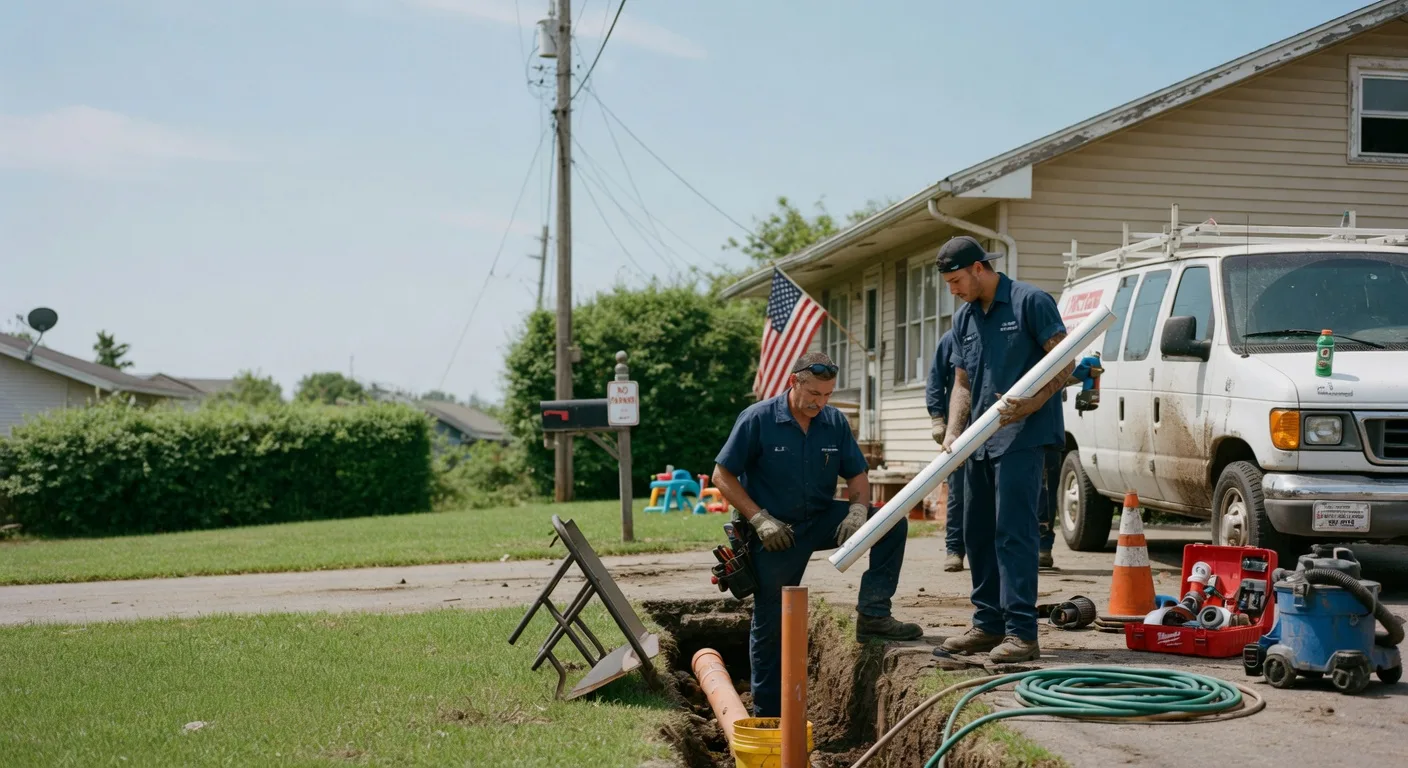
What is the difference between a septic system and a city sewer line for drain problems?
The two systems fail in different places, so the first job is knowing which one your home has. A city sewer line carries wastewater from your house to a municipal main, so trouble is usually confined to the pipe: roots at a clay joint, a bellied section, scale in old cast iron, or a blockage in the lateral. Every drain in the house backing up at once typically means the private line or the connection at the street. A septic system adds a buried tank and a drain field. Solids settle in the tank, and liquid flows out through perforated pipe into the soil. Slow drains or backups can mean a tank that is full and overdue for pumping, a clogged outlet filter or baffle, a failing drain field that can no longer absorb water, or a blockage in the short line between the house and the tank. Soggy ground or a strong odor over the tank area points away from the house plumbing. A cable machine or hydro jetting can clear the house line on either system, but jetting into a septic line needs care about where the water and debris end up. Property paperwork, a cleanout location, or the water utility can tell you which system you have. Expert Plumbers Co connects homeowners with an independent local plumber who works on that type of system.
Homeowners often assume a septic problem and a city sewer problem look the same from the bathroom, but there are a few quick clues. On city sewer, a backup after heavy use is usually the private line or the lateral at the street, and neighbors on the same main may have had the same trouble. On septic, the problem tends to build slowly: drains slow down across the house, the toilet flushes weakly, and a patch of lawn stays wet or unusually green. A common mistake is pouring additives into a septic tank hoping to fix a failing drain field. They do not repair soil that has stopped absorbing water. When you call, tell the plumber how old the system is, when the tank was last opened, and where the cleanout or lid sits. In older homes the tank may be buried deeper than expected and need to be located first, which adds time before any repair starts.
How often does a main sewer line actually need cleaning?
There is no set interval that fits every house. A main sewer line in good shape, with no symptoms, does not need cleaning on a calendar. A line with a known problem often does.
The usual reasons a main line needs repeat attention are root intrusion at a clay or loose joint, grease build-up on the pipe wall, or a bellied section that holds water and collects solids. Those problems do not go away after one cleaning. Roots regrow. A belly keeps holding water. A line like that may need cleaning on a schedule that suits what is found in it.
The way to set that schedule is a camera inspection. It shows the cause, the condition of the pipe and where the trouble sits, so the interval is based on what is in the line and not a guess.
Watch for the signs: slow drains in several fixtures, gurgling, a sewage smell, or the lowest drain in the house backing up. One slow sink is usually a branch line job. Several fixtures at once points to the main.
A cable machine is often enough for roots and soft blockage. Heavy grease or scale needs hydro jetting. A failed sewer lateral needs repair, not cleaning, and cost then depends on access, the materials, how much is opened up and any permit required. If sewage is backing up, stop running water and call. Expert Plumbers Co is a referral service. We refer you to a local plumber for Drain Cleaning or Emergency Drain Cleaning in Watson, AR: (380) 262-9173.
What you notice between cleanings is more useful than the date on the calendar. Keep a simple note of when drains slow, when gurgling starts and how long each cleaning lasted. If the gap between problems keeps shrinking, the cause is getting worse and a camera inspection should come before the next cleaning. Older homes with clay or cast iron mains often show roots or scale returning within a year or two, while newer plastic mains usually stay clear much longer unless a joint has shifted or something was flushed that should not have been. A common mistake is paying for repeated cleanings without ever seeing the inside of the pipe. After a thorough cleaning and inspection, ask the plumber what the line looked like, how much was removed and when it makes sense to look again, so you leave with a plan.
Are flushable wipes really a problem for drain lines?
You flush a wipe that says flushable, and a week later the toilet is slow or the whole line gurgles. Yes, they are a problem.
Toilet paper falls apart in water within minutes. Wipes are woven fibre and hold together. They travel down, then catch on a rough spot: a clay joint, a root hair, a bend, or a coat of grease on the pipe wall. The next wipe snags on that one. Over weeks they twist into a rope that traps paper and everything else behind it.
Signs to watch for: a slow toilet, gurgling from a tub or sink when you flush, or a clog that keeps returning a few weeks after it is cleared.
Safe homeowner check: stop flushing wipes and try a plunger on the one toilet. Do not keep flushing to see if it clears. If water is rising toward the rim, stop and wait.
Stop running water and call now if more than one drain is backing up, or if sewage shows in a floor drain or tub. That points to the main line, not the toilet.
A cable machine often pulls a wipe mass out of a single branch. A packed main line, or one with grease or roots in it, may need hydro jetting, and a camera shows which. Cost depends on access, how far down the line the blockage sits, and how much has to be opened. Expert Plumbers Co is a referral service. Call (380) 262-9173 for Emergency Drain Cleaning referrals in Watson, AR.
To stop it coming back, give the plumber the full history of what has gone down the toilet, including the brand of wipe and how often. Many packages say flushable, but that is a label, not a test the pipe has to pass. Keep a small covered bin next to the toilet so the habit is easy to change, and tell everyone in the house, including guests and children. If a wipe mass has been pulled out of the line, ask to see it, because its size gives a rough idea of how much is still lodged further along. In older homes with clay or cast iron, rough joints and scale make the pipe catch wipes far sooner than smooth plastic pipe does, so a line that took them for years can suddenly start clogging. After the line is cleared, a slow toilet that stays slow suggests another cause.
Why did my drains stop working in freezing weather?
Every drain in the house is slow or dead, something is gurgling, and it started on a hard-frost morning. Where Watson, AR gets a hard freeze, that usually points to ice in a pipe or ice at the top of the vent stack.
Frozen lines first. In colder states a sewer lateral can sit shallow enough for frost to reach it. Any sagging section holds a little water, and that water turns to ice. An un-insulated drain in a crawlspace or garage can freeze the same way.
Then the vent stack. Warm, damp air rises through the vent and meets freezing air at the roof opening. Frost builds ring by ring until the opening closes. With no air coming in, drains cannot flow. That is the gurgling you hear.
A frozen line and a root blockage look identical from inside the house. Both give slow drains and standing water. The weather, or a camera inspection, tells them apart.
Do not pour boiling water down a frozen line. Sudden heat can crack cast iron or split a trap, and then you have a leak too.
Safe homeowner check: see whether one fixture is slow or every drain is, look at the roof vent from the ground, and feel exposed pipe for a cold, stiff section.
Stop running water and call now if every drain is backing up, water is rising in a tub or floor drain, or you smell sewage. A single slow sink is usually a trap or branch job a cable machine can clear. A whole-house freeze-up or a suspect lateral may need a camera inspection, thawing equipment or hydro jetting, which is where emergency drain cleaning comes in.
Expert Plumbers Co is a referral service. We connect you with an independent local plumber in Watson, AR. Call (380) 262-9173.
Once the thaw is done, expect the problem to come back unless the cause is fixed. If a shallow section froze, ask the plumber to note its depth and whether the pipe has a belly that holds water, since that spot will freeze again. A cold crawlspace or garage drain can be wrapped with pipe insulation, and heat tape made for drain lines can help in short cold snaps, but it must be installed to the maker's instructions. For a frosted vent, keep snow clear around the roof opening, and tell the plumber if the vent is narrow, since a wider vent closes up less quickly. In older homes the vent opening is often smaller and the drains less well insulated, so the same cold snap hits harder. After a freeze, watch for leaks at joints and traps as the ice melts, because expanded pipe can split quietly and only show water once it warms. If you see damp spots later, tell the plumber what happened.
Our walk-in shower has a long linear drain and it keeps backing up. Why?
Your walk-in shower has that long, slim linear drain along one wall or the back edge, and it keeps backing up. The water rises around your feet, drains slowly, then does it again a week later. There are a few reasons a linear drain behaves this way.
The channel is long and shallow, so it collects hair and soap scum along its whole length. Many linear drains also have a small outlet at one end or in the middle, often undersized compared to the flow from a large shower head. If the pan is built with a low slope toward the drain, water crawls instead of running, which leaves scum behind and lets hair settle. Under the cover, the trap or the first section of pipe can also fill with hair, so the channel looks clean and still backs up.
If only the shower backs up and the sink and toilet in the same bathroom are fine, the problem is the channel, its outlet, the trap or the shower branch. If other fixtures are slow or gurgling, or water shows in a floor drain, the line further down is involved.
Safe homeowner check: lift out the grate or cover and clean the channel with gloves. Look at how water moves across the floor, because standing water on the pan suggests a slope problem rather than a clog alone. Skip chemical openers.
Stop running water and call now if sewage or gray water comes up elsewhere, if you see moisture on the ceiling or walls below the shower, if the floor around the shower feels soft, or if a sewer smell comes with the backups. A leaking pan is a different problem from a clog and can damage the structure.
A cable machine is usually enough for hair and soap in the trap or short branch, though the plumber must be able to get past the channel outlet. If the problem keeps coming back, a camera inspection can show a belly, offset or roots beyond the shower. Hydro jetting may be proposed when the pipe wall is coated with grease or scale.
Expert Plumbers Co is a referral service. We connect you with an independent local plumber in Watson, AR. Call (380) 262-9173.
Ask the plumber whether the cause is the drain body, the slope of the pan or the pipe beyond it. If the slope or outlet is the problem, ask what it takes to correct it. The scope depends on access to the drain, the parts or materials needed, how much tile or floor has to be opened up, and any permit or code requirement.